About
Hi, I'm Lars.
It's just me back here.
Every artist on this label is a project of mine, made in one room in the Netherlands, and it has worked that way since 2019. I know how that sounds when you say it out loud. If you're curious, here is why I do it this way, what I've come to believe about songs, and how the whole thing actually works.
First, the honest bit
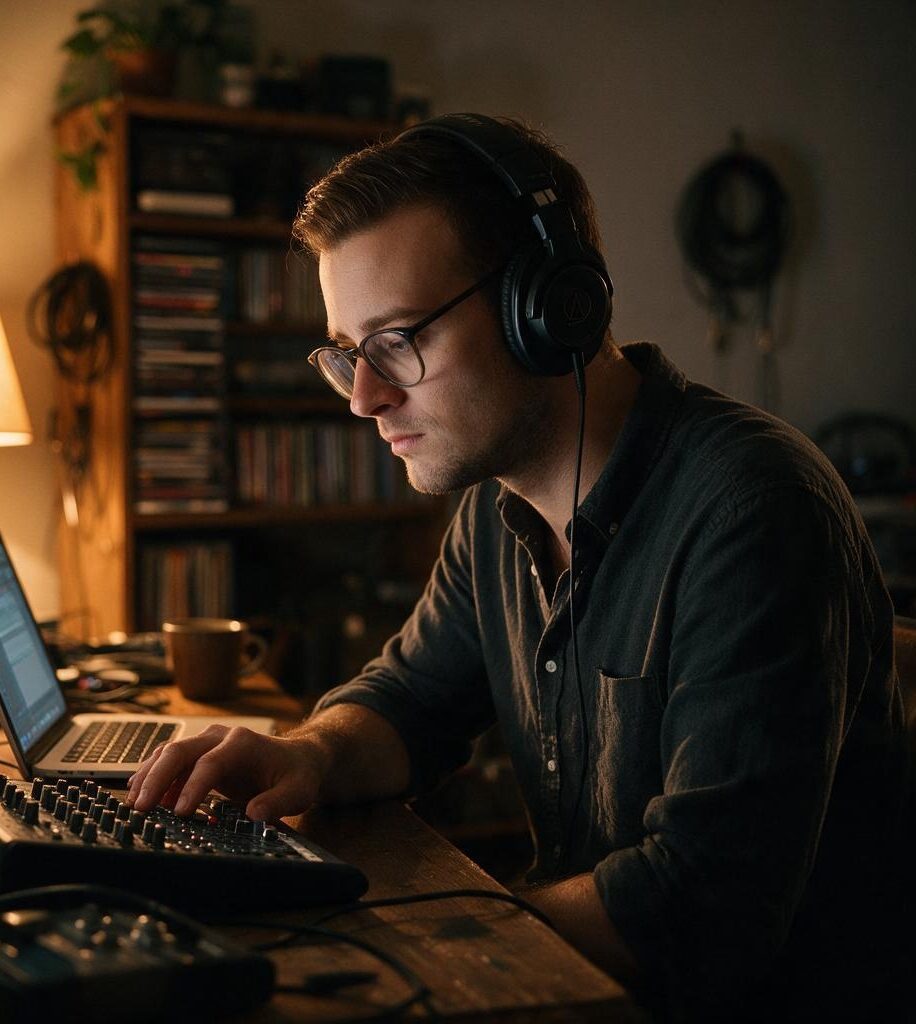
My name is Lars Curfs. I am not a label executive and there is no team behind me. No A&R department, no studio with a waiting list, nobody in a meeting deciding what comes out next. Just me, a laptop, a piano, and far too many unfinished ideas sitting in my phone.
NovelGrooves is where the finished ones end up. Every artist here is a project with its own name, its own sound and its own story. Some people find that strange, and I would rather tell you myself than have you work it out later and feel misled. If you want to know who I am when I am not making music, larscurfs.nl has that version of me.
It starts with loving music too much
You know that thing where a song gets stuck in you and you play it forty times and then start wondering how they did the drums? That is most of my life. I never grew out of it. And it never picked a lane: I can be deep in a children's song on Tuesday, a drill beat on Thursday and a worship ballad on Sunday, and enjoy all three completely.
That is not a strategy. It is just what the week looks like when ideas keep arriving and you cannot bring yourself to throw them away. So instead of forcing everything into one style, I let each idea become whatever it wanted to be. That is how a label ends up with a Cuban son record and a nu-metal record on the same shelf.
What they share is the standard. I sit with an idea until I find the thing that makes it work: a melody worth humming, a hook that stays put, a drum pattern that moves a room. If it does not feel right when I play it back, it does not go out. That is about the only part where I am strict with myself.
The long detour
I got serious about media in 2008, and by 2009 I was studying media management and thinking about very little else. From there I spent more than a decade in digital music distribution, which meant I was surrounded by music all day. Other people's music.
My own work kept getting pushed to the side. Not for lack of ideas: I was producing constantly and had sketches piling up everywhere. What I did not have was the knowledge, the time, or frankly the persistence to see them through, and the business took most of what I had. It is a strange position, spending your working life helping other people's records reach the world while your own sit unfinished on a drive.
What changed is not that I suddenly got more talented. The tools got good enough that I can work efficiently and stay organised, and that turned out to be the missing piece.
Where the time comes from
All of this happens alongside a full-time job, which is the question I get most often. The honest answer is that it runs on small habits. An idea turns up, I record a voice note on my watch before it disappears, and in the evening I type those into emails to myself. When a proper block of time appears, I open the list and start working (the process page covers what happens next).
And then there are the evenings where the kids are finally asleep, I tell myself I will just check one thing, and I look up and it is one in the morning. Time does something strange when a song is nearly working.
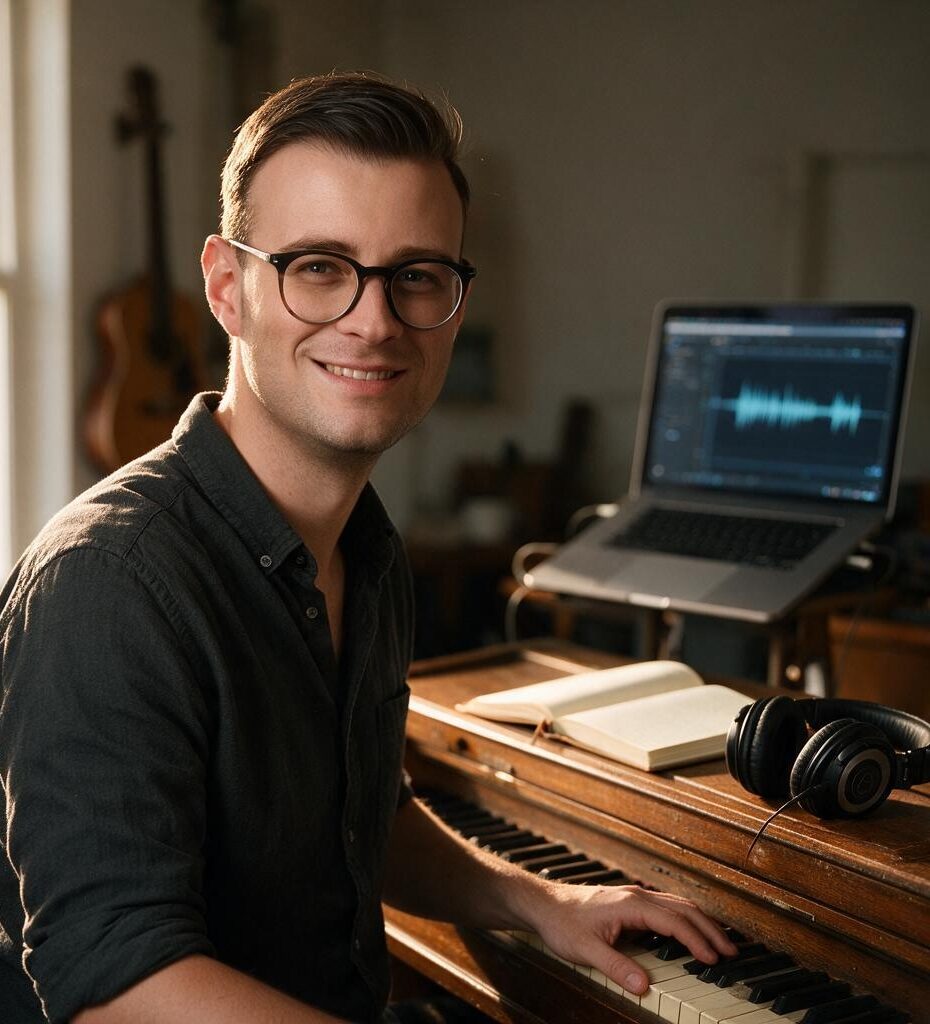
Studio is a generous word for it. It is a proper desk with a few monitors, a solid Windows laptop, a MacBook Pro, a bass, an electric guitar, keys, some outboard gear and a great deal of software. Nothing glamorous, but everything I need.
Why so many names
I could release everything under my own name. I have never really wanted to. What pulls me in is not having one recognisable signature; it is telling stories. Writing as different people lets me follow a song wherever it wants to go, without stopping to ask whether it fits some larger idea of me.
Cardinal Lowend, Hemelblad, Los Marindas: none of them are trying to be each other, and none of them should be. Each gets its own sound, its own look, its own pace. NovelGrooves is just the room where all those stories get to live at once. I treat them like real artists because that feels like the right way to treat the songs.
The one rule I actually follow
Here is something I noticed years ago and could not unnotice. Switch on the radio in the Netherlands and you will hear songs in languages most listeners do not speak sitting comfortably near the top. You will hear rap so blurred you could not transcribe a line of it, pulling in millions of streams. Year after year, lyrics nobody can quote, and audiences who do not seem to mind at all.
That bothered me until it taught me something. If the words are not carrying the song, what is? Melody. A hook that lands the first time. A phrase you can hum before you have understood a word of it. Lyrics still matter to me, and I work hard on them, but they are not the engine. They give the voice something good to ride on.
Get the melody right and the words do not have to do the heavy lifting. Get it wrong and no clever line will save you; I have tried, more than once. And every so often both land at once and a song does something I did not see coming. Those are rare, and they are the ones that keep me going.
The money part, said out loud
There is nothing cynical about wanting your music to be used.
The best songs ever written were commercial too.
Pay attention to what plays under the videos you scroll past: the loop behind an edit, the track under someone's wedding montage or gym progress clip. Almost nobody choosing those songs knows who made them. The song just sounds right. It fits the mood. It clicks into place under the picture.
Every time one of those clips gets watched, whoever made the audio earns a fraction of a cent. A fraction of a cent, multiplied across enough plays and enough creators and enough platforms, stops being a fraction. That is the honest answer to how one person keeps doing this and keeps the lights on.
I think the art-versus-commerce argument is mostly a luxury held by people who never had to choose. I try for both at once: something I would not be embarrassed to play for a musician I respect, and something a stranger can crop into a thirty-second loop. In my experience those two goals fight each other far less than the industry pretends.
But doesn't this ruin music?
People do ask, sometimes politely and sometimes not. One person behind many artists, releasing every week, melodies built to work in a feed. Does that not water down what music is meant to be? It is a fair question and I would rather answer it than dodge it.
My honest view: the industry has been changing for twenty years and it never asked any of us for permission. Streaming flattened the album. Algorithms decide what gets heard. Sync licensing pays better than radio ever did for people at my level. One person can now do what used to need a building full of them. The choice is not whether to change, it is whether to change on purpose or get rolled over.
So I chose on purpose. Not because I think I have outsmarted anything, and I am well aware I might be wrong about plenty of it. But the alternative was waiting around for a version of the business that is not coming back. What matters to me is what you make inside the new shape of things, and whether you make it with care. I try to, and I do not always get there.
How the music gets made
Every song here is written, composed and produced by me. The melodies, the words, the arrangements and every final call are mine. The toolkit is whatever the song needs: instruments, samples, modern production software and, like a lot of the industry now, AI as one assistive tool inside a very hands-on process. The technology helps shape sound. It does not make the choices that turn a sketch into a song; I do, and I spend a long time on them.
Because of that, the work is registered and treated as original, AI-assisted authorship in line with Buma/Stemra's guidance, and I document the process where that makes sense. If you want the whole route from voice memo to finished mix, I wrote it out step by step on the process page.
What is underneath
There is usually a thought behind a release, even when that thought stays mine. And the songs themselves carry more of me than the invented names suggest: things I have turned over more than once, things I was glad to get out of my head, things I could only say properly by handing them to someone who does not exist.
So the made-up names are not a way to hide. They are how I get to be honest from more angles than one voice could manage. And if a song of mine ever lands for you at the right moment, that is the whole reward. That is the same reason any of us keep music around.
What I'm bad at
Marketing. Genuinely, hopelessly.
The making I have a handle on by now, and so is everything behind it: distribution, licensing, registration, the whole administrative tail that nobody tells you about. But actually getting a new release in front of people is the part that keeps beating me. I finish something I am proud of, put it out, and then more or less stand there hoping.
So if this is your thing, or you simply have a smarter way of going about it, I would love to hear from you. Send me a note at info@novelgrooves.com. I am not asking you to sell me anything, I am asking because you probably know something I do not.
And about the charts
None of this is built around chart ambitions. The numbers do not need them and I am not aiming for them. But every now and then a song lands somewhere I did not expect. A hook catches. Someone with a following uses it. A playlist editor picks it up. I would be lying if I said that was not a good day.
So it would not shock me if one of these eventually turns up in a chart somewhere. It is not the point of any of this. I am also not going to pretend I would hate it.